
About the Open Agroecology Laboratory
Motivation
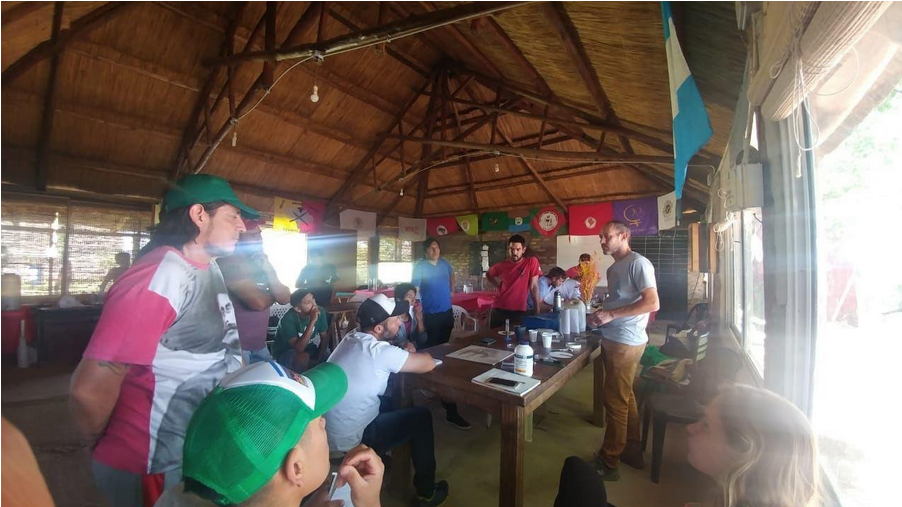
Agroecology is a holistic and integrated approach that simultaneously applies ecological and social concepts and principles to the design and management of sustainable agricultural and food systems. Agroecology is at once a science, a set of practices and a social movement. In recent decades, its scope has expanded from fields and farms to encompass agriculture and food systems as a whole.
Farms and agroecosystems that apply agroecological principles are widely recognized as having great potential to address the many dimensions of the current global socio-ecological crisis—climate change, biodiversity loss, environmental pollution and the loss of biocultural resources—while building food sovereignty.
However, agroecology is still at an early stage of adoption among some peasant and family-farming sectors. This is due not only to structural constraints, but also to how knowledge is generated, recovered and exchanged among farmers, technical teams and institutions working in agroecology. The prescriptive advice that agrochemistry offered individual farmers has no direct replacement in agroecology, which requires a different kind of knowledge about the agroecosystem: it is situated, process-based production rather than input-dependent production like hegemonic industrial agriculture.
Background and journey
For the earlier conceptual and technical development, see Background and workflow in Digital Infrastructure.
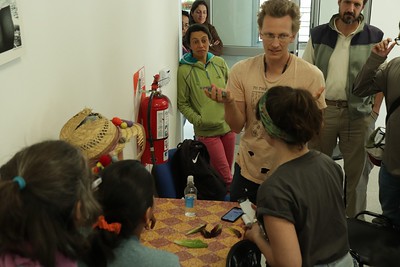
First soil knowledge dialogue.
AgroPacha workshops during the remote UROS residency.
Open technology residency and proof of concept.
Agroecological Commons: questions, analysis and circulation of knowledge.
Soil Health Kit, technical workshops, D:food/web and Kompost Festival.
How it works: a co-designed infrastructure
Considerable effort is being devoted to co-designing the Open Agroecology Laboratory infrastructure, both as a technological platform and in its human and relational dimensions.
One key lesson from our experience is that individual farmers rarely have the time, motivation or knowledge to use tools or digital technologies to systematize their own experience or test a soil sample. This is why we work with rural organizations and communities already organized around a technical-support institution or a shared—usually productive—interest. Knowledge-building and exchange are more effective among peers, and communities provide a place for dealing with individual uncertainty and frustration. The Laboratory also enables collaboration with researchers and technical teams who share knowledge in the spirit of Freirean popular education: everyone has something to share and something to learn.
We established and tested a conceptual framework for understanding how tools, communities and organizations can be integrated into concrete infrastructures that serve everyone involved.
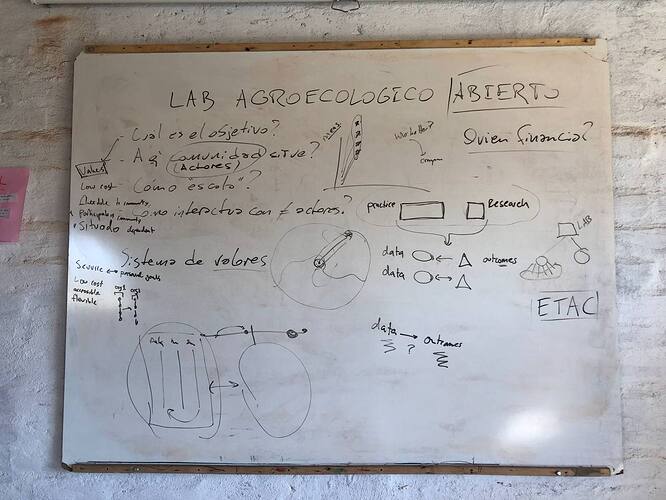
1 · Ask
Communities frame situated questions about soils, farms and practices.
2 · Observe
Contexts are recorded, samples are collected and open protocols are applied.
3 · Interpret
Data are organized, visualized and interpreted collectively.
4 · Share and improve
What is learned returns to the territories and improves methods and tools.
We believe open technologies can support the practical and pedagogical dimensions of agroecological transitions. They offer an opportunity to co-create the tools needed to produce knowledge, drawing on projects around the world, recreating what works and changing what does not to make designs useful in context. This flexibility and potential for appropriation are what we need to follow, systematize and share lessons from local agroecological transitions.
To do this, we create opportunities to test designs in the field, in dialogue with local actors, and adapt or develop methods and tools that are useful to their users and particular contexts.
We also see the Laboratory as a bottom-up approach to digitizing agroecological experiences. It can strengthen the public recognition of agroecology—for example through participatory guarantee systems—while resisting an AgTech wave that risks increasing pressure on small farmers and their technological dependence on corporations.